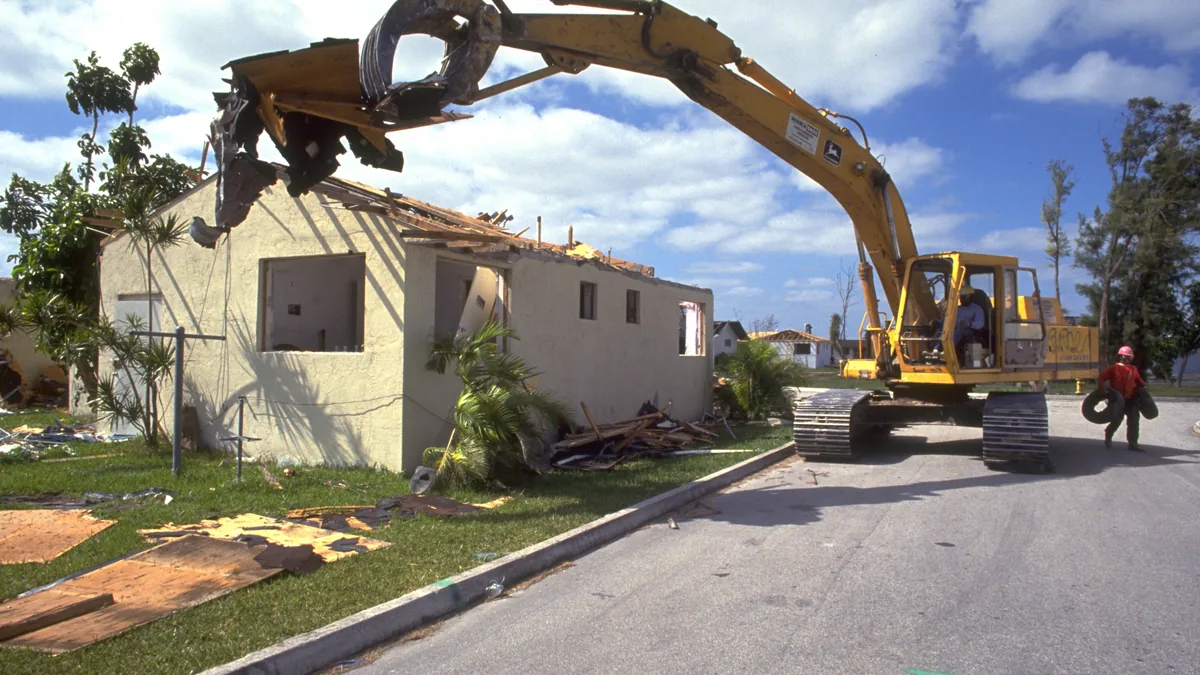
Hurricane Andrew struck southern Dade County on August 24, 1992, and was later upgraded to a Category 5 hurricane. The National Hurricane Center's report on the storm is still the baseline for understanding how badly roofs and openings failed, and why Miami-Dade and Broward now sit in the Florida Building Code's High-Velocity Hurricane Zone. The code does not make a house waterproof. It is the wind-resistance standard those two counties build under today.
What the official report recorded
The National Hurricane Center's Andrew report, on the agency's 1992 storm page, includes several points that still matter for homes in the southern part of the county:
- The storm's damage was extreme from the Kendall district southward through Homestead and Florida City.
- A storm tide peaked at 16.9 feet at the Burger King International headquarters on the western shore of Biscayne Bay.
- The report counted 25,524 homes destroyed and 101,241 damaged, and about $25 billion in damage in the United States, in the figures used at the time.
Those numbers are why Andrew is not treated as just another named storm in local memory. A later upgrade to Category 5 did not change what the houses had already been through. It confirmed how strong the wind had been.
The 16.9-foot tide on the bay is a separate fact from the wind field inland. A house can have had roof and opening failures from wind, floodwater from the bay, or both. Andrew is often remembered for the wind; the official report also recorded a serious storm tide. If a similar storm happened again, you would still photograph both the failed openings and any exterior waterline, rather than treating every wet room as the same kind of claim.
This post does not invent a percentage of houses that were concrete block, or a precise share of losses that came from rain versus surge. Concrete-block masonry homes are common in South Florida, a point a later National Hurricane Center building-performance discussion also treats as common rather than as a measured share. What the 1992 report supports, and what later code changes responded to, is the failure of roofs, openings and poorly connected structures under extreme wind.
What the High-Velocity Hurricane Zone is
The Florida Building Code's High-Velocity Hurricane Zone provisions apply in Miami-Dade and Broward. They include, among other sections, rules for reinforced unit masonry. The HVHZ is a geographic designation in the code, not a marketing label a contractor can claim for a single product.
For a homeowner, the practical meaning is narrower than "the house cannot leak":
- New work and many substantial repairs have to meet a wind standard that is stricter than the standard used in much of the rest of the state.
- Openings — windows, sliders, doors and roof systems — are where a storm still gets water inside if they fail or if rain is driven through a gap.
- After a storm, photographs of a failed opening, a peeled roof edge or an intact shutter line are how you show whether rain came through wind damage, which is the question a wind or homeowners policy asks.
HVHZ compliance is not flood insurance, and it is not a promise that king-tide or surge water will stay outside. Those losses are a different path, described in flood or wind.
After any later storm, walk the house with a camera before you start demolition. A missing roof covering, a bent shutter, a failed sliding-door latch, or a punctured soffit is evidence of an opening. A waterline on a garage column or a patio wall is evidence of rising water. Those two kinds of pictures answer different policy questions, and they disappear if the first step is a rushed teardown.
What to take from Andrew without over-reading it
Andrew's worst damage was concentrated from Kendall south through Homestead and Florida City. That does not mean a house north of that belt is exempt from wind-driven rain, or that a house in that belt will automatically fail. It means the official record already tells you where the extreme wind field was, and that today's code in Miami-Dade exists in that shadow.
If you are preparing for the current season, the hurricane prep checklist is the practical list: openings, shutoffs, photos and flood coverage. If water does get in, water damage restoration describes the usual extraction and drying work. For houses in the Kendall district named in the Andrew report, the Kendall area page covers local housing and flood notes.
This site is an independent referral service. If you send a request, one local provider may contact you about your home.
FAQs
When did Andrew hit Miami-Dade?
The National Hurricane Center reports that the storm struck southern Dade County on August 24, 1992. It was later upgraded to Category 5.
How high was the storm tide?
The official report lists a peak of 16.9 feet at the Burger King International headquarters on the western shore of Biscayne Bay.
Does the HVHZ code apply only in Miami-Dade?
No. The High-Velocity Hurricane Zone provisions apply in Miami-Dade and Broward.
If my house was built to HVHZ rules, do I still need flood insurance?
Yes, if you have a flood risk you want covered. The code is about wind resistance. Flood is a separate policy, and a standard homeowners policy generally excludes it.
Sources
- National Hurricane Center, Hurricane Andrew.
- Florida Building Code, High-Velocity Hurricane Zones, reinforced unit masonry.
- FEMA, Flood Insurance.